
About
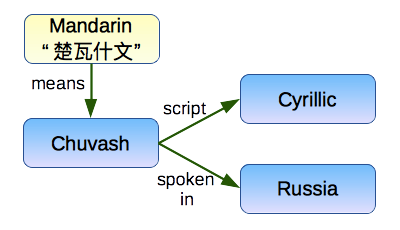
Who uses Lexvo.org?


Lexvo.org brings information about languages, words, characters, and other human language-related entities to the Linked Data Web and Semantic Web. The Linked Data Web is a worldwide initiative to create a Web of Data that exposes the relationships between entities in our world. Lexvo.org adds a new perspective to this Web by exposing how everything in our world is connected in terms of language, e.g. by considering semantic relationships between multilingual labels (like book or New York). Lexvo not only defines global IDs (URIs) for language-related objects, but also ensures that these identifiers are dereferenceable and highly interconnected as well as externally linked to a variety of resources on the Web. Some of the main features up to date:
Words: Lexvo.org provides identifiers for terms in specific languages.
Linked to many external resources (WordNet, thesauri, ontologies, etc.).
Examples: English 'school', Chinese '朋友'
| Lookup |
Languages:: Over 7,000 language identifiers with information about them,
including multilingual names, scripts, geographic regions, etc.
Examples: Spanish, Afrikaans, Oriya, Taungyo
Scripts: Identifiers for scripts
Examples: Latin and Cyrillic scripts, Indian Devanagari,
or the Korean Hangul system
Characters: Based on Unicode, linked to scripts,
with semantic information about CJK characters
Examples: U+5091 ('傑'), U+0047 ('G')
Also:
Geographical regions based on ISO 3166-1 / UN M.49 standards (example).
Semantic concepts based on WordNet (example).
Chinese character KangXi radicals (example)
etc.
Lexvo.org Ontology: General properties to describe classes and relationships,
including identity links.